ModulesManagement of ChangeProcess Safety
Changes reviewed before they reach the plant.One case, from the first screening to the verified close.
For plant engineers and PSM coordinators: screen the change, answer each impact path, take it through your approval steps, and keep a temporary change on its reversion date. Permanent or temporary, it is the same case.
- Screened as
- MOC required
- Reason
- New trim, Cv 18 → 25; fail action unchanged
| Impact path | Affected |
|---|---|
| Documents and procedures | Yes |
| Training | Yes |
| Process safety information | Yes |
| Hazard study | Yes |
| Emergency response | Not applicable |
- Hazard
- Propane release at the valve body
- Consequence
- Fire in the vaporizer area
- Safeguards
- PSV-201 · gas detector GD-204
- Affected function
- Flow control to V-201
- Controls
- Pressure test before return; operator on local control
| Step | Role | Approver | Required | Decision | Date |
|---|---|---|---|---|---|
| 1 | Process engineer | Sarah Mitchell | Required | Approved | 21 Oct 2026 |
| 2 | Operations manager | Daniel Okafor | Required | Approved | 22 Oct 2026 |
| 3 | Process safety | Emma Clarke | Required | Waiting | — |
- Start-up review
- Yes · PSSR-2026-0007
The same valve, three screenings. An example case; the fields are the product’s, the values illustrative.
Where it connects
On the same loop: Process Safety Information, Document Manager, Chemical Management and 37 more modules in one workspace.
Method note
Every change through MOC, or only the ones that matter? Both schools are right.
Cast the net too wide and people route around it. Too narrow, and the change that hurts is the one nobody screened.
Leandro · Founder, UProcess
One school sends every change through the full review, so nothing is judged only by the person who wants it done. The other screens first and lets a true replacement in kind go with a recorded reason, because a process that reviews every gasket stops being read.
So every case is screened first, and the screening stays on the record.
- Replacement in kindScreened as like for like, with the reason kept on the case. That closes the case.
- Permanent changeImpact paths, risk items and the approval steps your template sets.
- Temporary changeThe same review, plus a reversion date the case keeps in view.
Where Management of Change usually breaks
Four places change control goes wrong, and what the case does about each.
The temporary change nobody designed.
At Flixborough in 1974 a temporary pipe was fitted between two reactors with no engineering drawings or calculations, and approved by someone without the qualifications to judge it. Temporary changes get the least review and often stay the longest.
Source: IChemE Loss Prevention Bulletin 269
In UProcess A temporary change takes the same stages and approval steps as a permanent one, and carries a reversion date. Past that date the case is flagged as past reversion to its creator and to owners and admins.
MOC-2026-0034 · temporary change
- Change
- Hose connection around FV-1410 during repair
- Approved
- 28 Oct 2026 · 3 of 3 steps
- Reverts
- 14 Nov 2026
- Today
- Past reversion by 2 days
Shown to the case creator and to owners and admins. Nothing reverts by itself.
The review that comes after the hardware.
At the Williams Olefins plant, the CSB found that block valves able to isolate a reboiler from its relief device went through a delayed MOC, and that review did not identify a major overpressure hazard.
Source: U.S. Chemical Safety Board
In UProcess Impact assessment and risk items come before approval, and each approval step records its approver, decision and date. A rejection needs a comment and sends the case back to scope.
MOC-2026-0031 · history
- 14 Oct
- Scope opened · Sarah Mitchell
- 15 Oct
- Screening recorded · MOC required
- 17 Oct
- Impact assessment complete · 1 risk item
- 21 Oct
- Step 1 approved · Sarah Mitchell
- 22 Oct
- Step 2 approved · Daniel Okafor
- —
- Step 3 waiting · Emma Clarke
Implementation opens after the approval steps.
The change nobody called a change.
A review of organisational change at a UK chemical site found shift changes treated as like for like, staff unsure which changes needed review, and the paperwork done afterwards, if at all.
Source: IChemE Hazards 29
In UProcess Every case starts with screening: MOC required, or replacement in kind, with the reason recorded on the case. A replacement in kind closes the case there. The history dates every stage, so a review done after the work shows when it was done.
Screening · MOC-2026-0031
- Screened as
- MOC required
New trim changes Cv from 18 to 25. Not like for like.
Recorded 15 Oct 2026 · Sarah Mitchell
The workaround that becomes the way it runs.
The CSB’s bulletin on managing change says the method should cover operational deviations and variances, not only planned projects. A protection left bypassed is a change no one approved.
Source: U.S. Chemical Safety Board, safety bulletin
In UProcess A bypass past its time limit can be proposed as a temporary change, pre-filled from the bypass. The case shows the bypass it covers, and the bypass follows the case’s reversion date once approved.
MOC-2026-0035 · from a bypass
- From bypass
- BY-0041 · PSHH-1405 trip inhibited
- Limit
- 72 h · passed by 9 h
- Proposed as
- Temporary change · reverts 20 Nov 2026
- Bypass reads
- Past limit by 9 h
Pre-filled from the bypass. The bypass is never changed from the case.
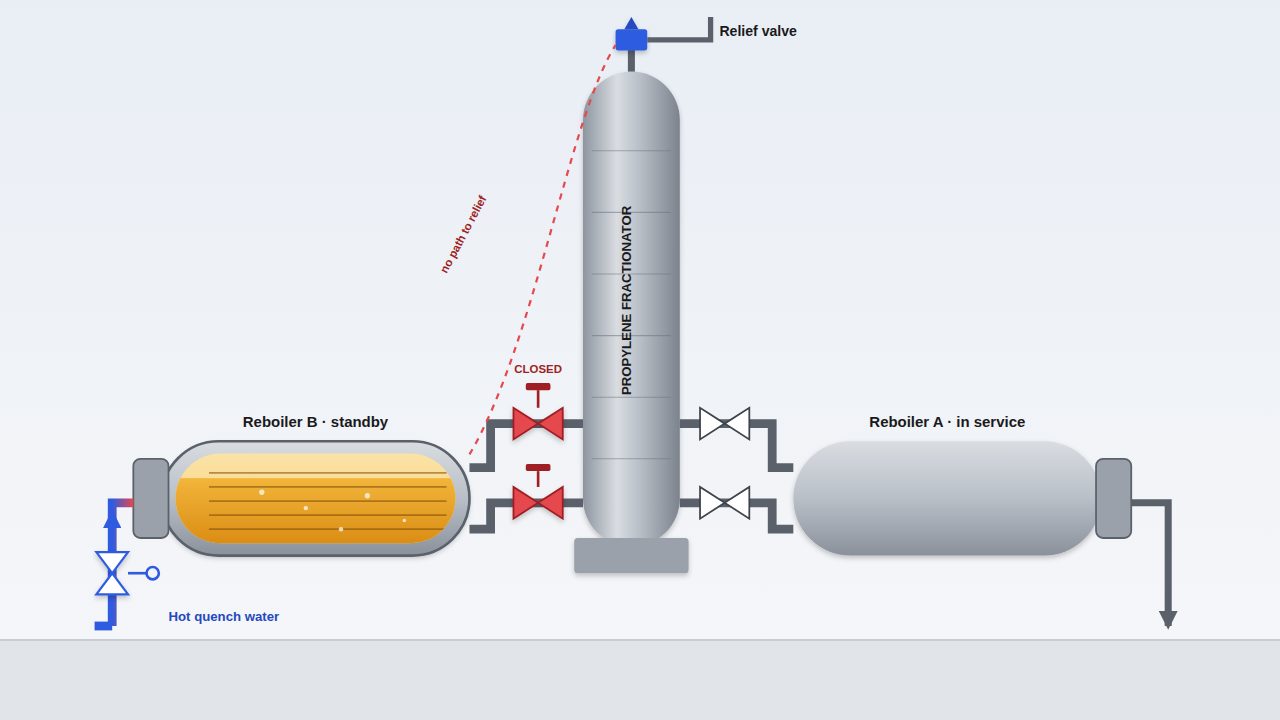
Process accident case · Standby reboiler
The spare reboiler that was already full.
The paperwork said it was protected. The valve in the field said otherwise.
Case MOC-2026-0031Template Process change · 3 stepsRevision Resubmitted 20 Oct 2026
| Step | Role | Approver | Required | Decision | Date |
|---|---|---|---|---|---|
| 1 | Process engineer | Sarah Mitchell | Required | Rejected · “Add the pressure test to the return-to-service steps” | 18 Oct 2026 |
| 1 | Process engineer | Sarah Mitchell | Required | Approved | 21 Oct 2026 |
| 2 | Operations manager | Daniel Okafor | Required | Approved | 22 Oct 2026 |
| 3 | Process safety | Emma Clarke | Required | Waiting | — |
The record an auditor asks for.
Who approved what, and when, is part of the change, not an email thread.
- Every approval step with its role, named approver, decision, date and comment.
- Each impact path answered yes, no or not applicable, and the risk items behind the decision.
- The case history: each stage entered, returned, resubmitted or cancelled, by whom and when.
- For a temporary change, its reversion date; for a change that needs one, the start-up review that took it as its basis.
What’s in a case
- Stages
- Scope, screening, impact assessment, approval, implementation, verification, closed. A stage opened out of turn says so, and points to the current one.
- Screening
- MOC required or replacement in kind, with the reason, kept with the case.
- Impact
- One answer per impact path your company defines, yes, no or not applicable, plus risk items: hazard, consequence, safeguards, affected function and controls.
- Approval
- The steps of the approval template the case uses, each required or optional, with named approvers.
- Temporary
- A reversion date on the case. Past it, the case is flagged until it is dealt with; nothing reverts by itself.
Questions
Do I need an MOC for a like-for-like replacement?
Your call, on the record. Screening marks a replacement in kind, and the reason stays on the case.
Who approves a change?
The steps of the approval template the case uses. Your company writes the templates, names the roles and marks each step required or optional.
What happens when a temporary change runs late?
Nothing reverts by itself. Past its reversion date the case says so, to its creator and to your owners and admins.
Does the MOC replace the start-up review?
No. A Pre-Startup Safety Review takes the MOC case as its basis, so the review names the change it checks.